
Play toward
- Play Toph where the ground itself becomes a question the opponent must answer.
- Use one Toph support choice at a time so variation stays measurable.
- React to observed escape habits rather than presumed fear.
Earth fighter dossier · Launch version
Toph is the launch earth-control specialist for players who want to own the floor, force grounded decisions, and verify support interactions before trusting launch-week hype.
On this page
Evidence status
Toph copy here uses the current official site and store, a clearly labeled preview-era support example, and early community routing. It does not invent frame advantage, combo routes, matchup charts, or damage values for Toph.
Reviewed July 24, 2026Character overview
Official launch copy presents Toph as the Blind Bandit who bends the battlefield itself. That is the safest day-one takeaway: she is supposed to feel grounded, disruptive, and different from the cast members who win through air mobility or stance changes.
She also appears repeatedly in support-system explanations. That makes support choice part of the basic lesson, not an advanced extra. Learn one support, test what it changes, and keep conclusions tied to the build in front of you rather than to launch-week hype.
Character reel · Official reveal footage
Toph's official reveal shows the intended weight and floor-control identity without proving exact safety or damage. Use the clip to identify likely situations, then test Toph's grounded buttons, stone-pillar spacing, and support effects against recorded movement.
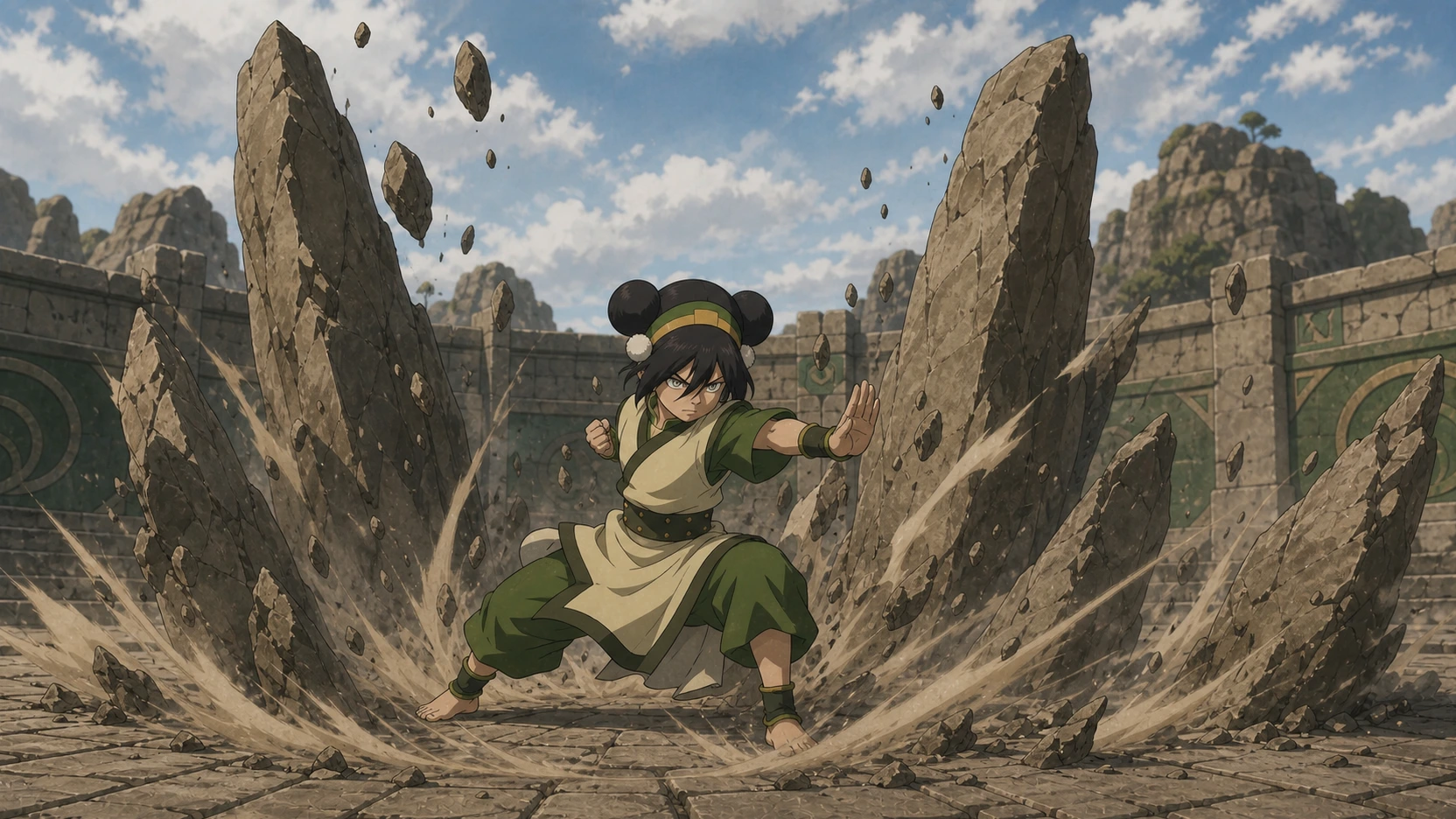
Record the exact distance where Toph's preferred poke and pillar connect, then compare the recovery on hit, block, and whiff.
Make the dummy jump from several ranges so Toph has one practiced response when the opponent leaves the floor.
Keep the starter and spacing identical when comparing Toph supports so the property change is visible.
Button labels use universal notation. Confirm the current command list and support effects in your own game build.
Launch identity
This is one of the clearest launch identities in the roster. Official copy sells battlefield control: forcing opponents to respect the floor.
That clarity is useful in a new fighting game. Broad identity cues are more trustworthy than hot takes, so the first lessons should revolve around spacing, support influence, and the difference between control and reckless commitment.
Confirmed support angle
A preview article uses an Earth Kingdom wrestler changing Toph's stone-pillar special as an example of support modification. Official sources confirm the broader rule that each fighter has three support choices that can modify abilities; verify that specific preview example in the current build.
So support testing belongs at the start. Different choices may stabilize neutral, make confirms clearer, or change how comfortable a route feels. Measure the change instead of assuming one rumor is best.
Match flow
She does not need a fantasy tier placement to teach useful neutral. The repeatable question is simpler: what space am I asking the opponent to fear right now?
Week-one neutral should stay conservative. Establish a lane, watch how people escape, and only then commit harder. Early success comes from observation before escalation.
Learning curve
A practical learner gets more from clarity than bravado. Start with one spacing check, one punish, one support choice, and one favorite screen position. Build in layers you can remember under pressure.
Some players want the loudest earthbending moments immediately. That often creates bad habits. A better plan is to box the opponent in first and cash out only when testing supports the read.
Early community layer
Early community material is already converging on support-specific changes, grounded setup language, and starter reference sheets. That is useful because it pushes new players toward documentation habits instead of pure outcome claims.
The limit is obvious: this material is still young. Use it to generate questions, then recreate the sequence in Training Mode and decide whether it survives guard, jump, and your own execution level.
Pick decision
This is a strong fit for players who enjoy making the other person uncomfortable before opening up offense. If you mainly want air routes or scramble-heavy chaos, another launch fighter may fit better.
The cleanest test is simple: ask whether the satisfying part is the hesitation before the hit. If yes, keep going. If the fun starts only once the round becomes chaotic, you may be fighting the rhythm.
Practical match plan
This launch-version playbook separates durable decisions from early community conclusions that may change after balance updates.
Training mode checklist
The shipped Training Mode exposes hitboxes, frame data, save states, and configurable situations. Use it to reproduce every exact claim.
Place the dummy at three grounded distances and identify where control feels most stable. Reset until you can name why each distance helps or hurts.
Run a full set of reps with only one support attached. Write one sentence about what that support changes before swapping.
Record repeated jump timings and test which answers feel dependable for your current execution rather than your ideal execution.
Set the dummy to block and vary defensive responses so Toph pressure is tested against something closer to a real opponent than a passive training dummy.
After matches, pull one failed control sequence into Training Mode and recreate it until you know whether the problem was spacing, timing, support choice, or panic.
Character questions
Toph can be a strong first main if you enjoy deliberate spacing and visible control goals. It is less friendly if you only want speed.
No reliable launch source proves that. Toph has strong official identity cues and a meaningful support system, but this guide does not invent a tier rank from week-one noise.
Test support influence first. A preview article uses Toph to illustrate a modified signature special, while official sources confirm only the broader three-support system. Measure the current-build variation yourself.
Only after you reproduce them. Clips are great for ideas, but routes still need to survive your version and your execution under Training Mode settings.
Source desk
Sources were reviewed on July 24, 2026. Live game behavior and storefront terms can change after publication.