Official sources define Fire Lord Ozai as a deliberately strong design problem, but the public evidence on how stable that strength really is still comes from first-day sets and launch discussion.
Reviewed July 24, 2026
Character overview
How Fire Lord Ozai approaches a match
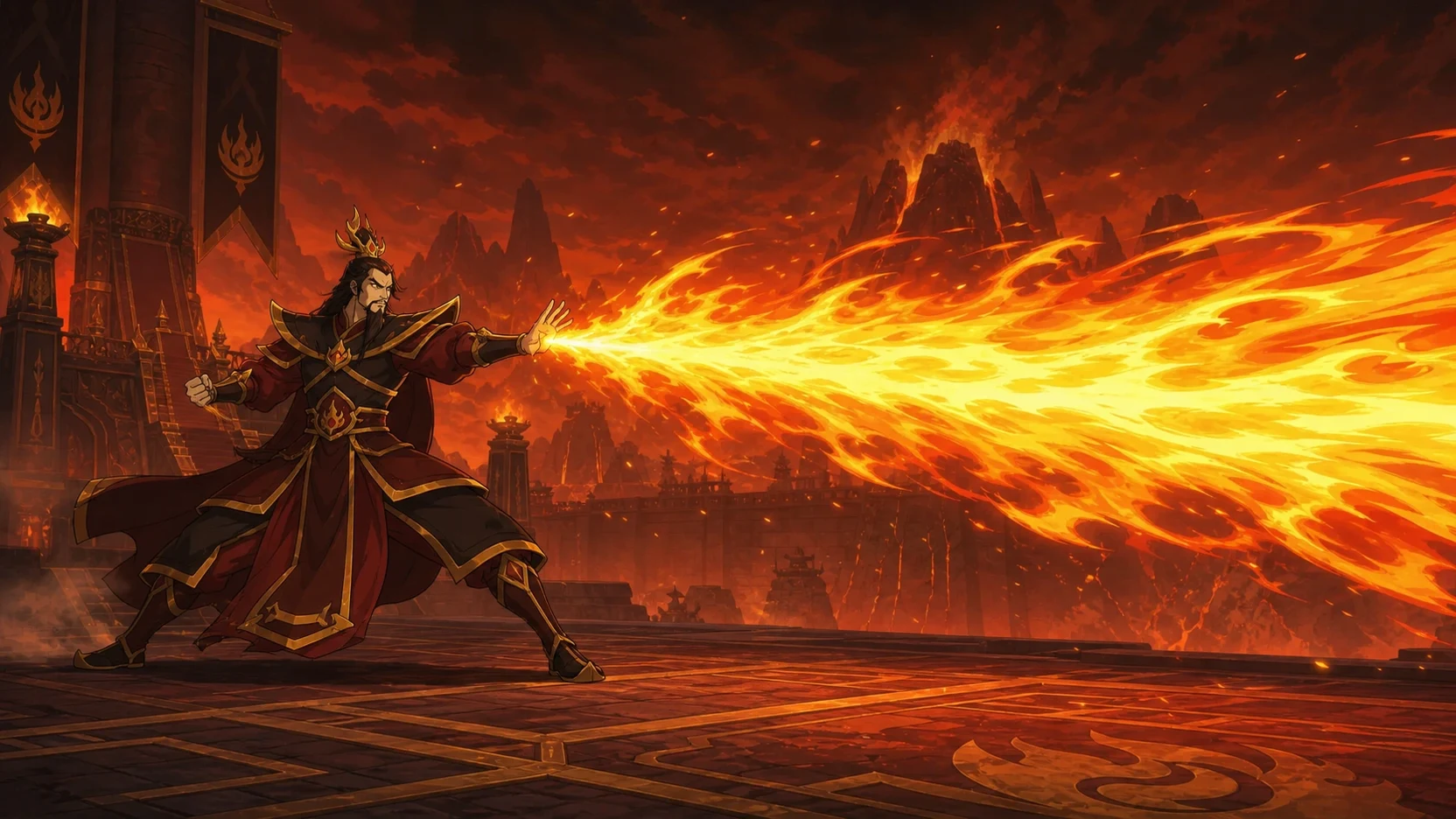
Fire Lord Ozai enters the roster with weight, but this page treats him as a design question, not a lore conclusion. Official material sells power and authority, not automatic control of matchups.
The most useful official clue comes from the July 20 AMA. When asked which character was hardest to design and balance, a developer answered Ozai and said the team felt he had to be strong. That is intent, not a finished balance verdict.
Launch-day players are now testing whether that intended strength survives real counterplay. Read every early claim through that lens. A short set can make the character look terrifying long before the field learns where the real checks are.
Archetype lens
Imposing fire pressure with visible commitment
Source priority
AMA first, launch threads second
What is confirmed
Tournament intent and deliberate strength
What is not confirmed
Tier placement, best support, exact punish rules
Best learner fit
Players who want presence more than trick routing
Character reel · Community launch footage
Fire Lord Ozai control study: pressure with evidence
A dedicated official Ozai technique lesson was not available during this review. The embedded launch-day gameplay is a community observation, not frame-data authority; use it to find questions, then reproduce every Fire Lord Ozai claim in Training Mode.
FIRE LABImposing range · testable recovery
VIDEO
Early Fire Lord Ozai GameplayKyng X2 · community launch footageOpen on YouTube ↗
Fire Lord Ozai control focus
A
Light
B
Medium
C
Heavy
F
Flow
01
Find the fast check
Identify Fire Lord Ozai's quickest practical button before organizing offense around the largest fire animation.
02
Measure the fire lane
Record mobile opponents using jump and Flow so Fire Lord Ozai's control tools are tested against movement, not a stationary dummy.
03
Audit blocked specials
Replay common Fire Lord Ozai special enders and test the defender's fastest response on block.
Button labels use universal notation. Confirm the current command list and support effects in your own game build.
Official baseline
What official roster language says about the slot
Official material around this slot is lighter than the coverage given to Aang, Azula, or Sokka, so the safest baseline is the broad roster framing. It presents a forceful fire villain with direct punishment appeal and visual authority, but it does not promise solved neutral, best support, or effortless offense.
That restraint is useful. When a page does not hand you exact pairings, advantage states, or matchup edges, the right response is not to invent them. The safest opening read is that this design should command respect quickly and then make the opponent prove they can stay calm.
Developer boundary
What the AMA actually confirmed
The AMA is the cleanest source because it states two things directly. First, Fire Lord Ozai was the hardest character to design and balance. Second, the team felt they had to make him strong. That should guide your lab work: search for tools that force fear, hesitation, and declared movement.
The AMA does not confirm top tier, invincibility, or perfect stability. In the same discussion, the team said every character was meant to be tournament viable. Put together, those comments describe a power character with risk, not a crowned king of the roster.
Launch read
How day-one community analysis is reading the slot
Day-one discussion has been dominated less by finished matchup charts and more by broad launch reactions: missing ranked mode, uneven onboarding, and a player base still learning core routes. That makes every strong-looking round louder than it really is.
One linked launch-day video frames Fire Lord Ozai as stronger than expected. Treat that single reaction as a temperature check, not a verdict: first impressions can overvalue visible control and under-measure adaptation.
Match plan
A practical neutral plan
Play this slot like someone who is supposed to make people hesitate. Do not rush to prove you can always be active. Hold ranges where the opponent changes movement, note when they stop jumping freely, and record which defensive choices only appear after one large commitment has been shown.
The second rule is discipline after fear. New players often assume that a strong-looking design justifies every bold follow-up. Launch-week evidence does not support that. Use early turns to learn what creates respect, then let Fire Lord Ozai cash that respect in with cleaner confirms, throws, or spacing resets.
Lab priorities
What players should test before trusting support advice
There is no credible consensus yet on the best support, and that matters. Support claims spread quickly because they sound actionable, but an underexplored character can look transformed by a partner when the real change is just unfamiliarity. Test whether a helper extends approach safety, covers retreat, or stabilizes pressure after a blocked sequence.
Keep those tests simple. Ask one question at a time, save the state, and repeat it ten times. If the support only looks amazing when the opponent never interrupts, jumps, or changes timing, it may be helping a fantasy version of the character rather than the one you actually bring into matches.
Review method
How to review matches without lore bias
Every replay should be reviewed with one anti-bias question: did this round work because the opponent respected the character, or because they understood the matchup poorly? Week one will generate accidental wins. Do not confuse those wins with proof that your sequencing is airtight.
A better review habit is to tag every big moment by cause: spacing, panic, hesitation, support coverage, or conditioning. Once you do that for several rounds, the pageantry drops away and the repeatable decisions remain.
Practical match plan
Fire Lord Ozai strengths, risks, and first priorities
This launch-version playbook separates durable decisions from early community conclusions that may change after balance updates.
01
Play toward
Use the slot to create visible hesitation before you overextend.
Favor sequences that keep the opponent in positions where they must declare movement.
Treat developer-confirmed strength as permission to test pressure, not proof that every pressure layer is safe.
02
Watch carefully
Do not convert narrative power into automatic tier certainty.
Do not trust first-day clips that hide the opponent response or support context.
Do not spend all of your momentum on one dramatic guess unless you have measured the downside.
03
Beginner plan
Find one grounded check, one anti-air answer, and one stable pressure ender.
Use support testing to answer a single weakness rather than chase highlight-reel extensions.
Review lost rounds to see whether the plan failed because of range, impatience, or matchup ignorance.
Training mode checklist
Verify Fire Lord Ozai before taking advice online
The shipped Training Mode exposes hitboxes, frame data, save states, and configurable situations. Use it to reproduce every exact claim.
01
Respect meter
Record three defensive responses after your preferred pressure starter: block, jump, and mash. Re-run them until you can identify which follow-up is real and which only works because the dummy stays passive.
02
Fear vs overcommitment
Play two-minute rounds where this slot is only allowed one large commitment every ten seconds. The goal is to learn how much space and hesitation it can create before you spend that moment.
03
Mobile target check
Use a fast-moving opponent and test how the character re-centers after whiffed control attempts. Log whether you are losing because the option is bad or because your spacing started too far away.
04
Support honesty test
Pick one support interaction and run it against three opponent timings. Keep it only if it still helps when the defender blocks, jumps, or delays rather than freezing in place.
05
Replay cause labels
Watch five rounds and tag every big hit as panic, spacing, conditioning, or scramble. If most success comes from panic, the next practice block should focus on stability when opponents stop panicking.
Compare another route
Related character guides
Use these pages to compare movement, execution, and decision style without turning element or story power into a tier claim.
No. The clearest official comment is that Ozai was hard to design and that the team felt he had to be strong. That statement is not the same thing as a confirmed top-tier ranking.
What is the safest takeaway from the AMA?
Treat Fire Lord Ozai as a deliberate power character whose exact balance is still being stress-tested by public play. The AMA supports strength, not certainty.
Should I trust launch-day Ozai tier videos?
Use them as scouting, not doctrine. Early Ozai analysis is valuable for seeing what players fear, but it is still too early for stable matchup or roster conclusions.
What should a new player practice first?
Practice presence before spectacle: one grounded check, one anti-air answer, one dependable pressure ender, and one support interaction you have personally verified.