The Avatar Legends The Fighting modes available in current official descriptions cover single-player narrative, individual arcade routes, structured character instruction, combo practice, a configurable training laboratory, local versus, online play, and an Art Gallery. Other online tools were marketed before release, but the July 23 launch newsletter places Ranked, lobbies, spectator tools, and keyboard mapping in post-launch work. This page therefore separates the current mode set from announced additions.
Story Mode answers “what happens when fighters from different Avatar eras collide?” Character Lessons answer “what can my chosen fighter do?” Training Mode answers “does this tactic work under controlled conditions?” Arcade answers “can I repeat my basic plan across several matches?” Online play answers “can I recognize and adapt to another person?” Treating one mode as the entire game leaves part of the learning loop unused.
Official sources themselves are not perfectly synchronized. The PM Studios page and portions of current storefront copy still describe a broader set, while the later launch newsletter identifies several of those same features as priorities for upcoming patches. This guide gives the dated launch update greater weight for delivery status. A mode’s presence is a fact only when current official evidence or the shipped build confirms it; promotional copy remains context, not a substitute for verification.
Mode reel · Official feature overview
Avatar Legends The Fighting modes in one field reel
The official feature overview distinguishes story content, practice tools, local play, and online competition. Choose an Avatar Legends The Fighting mode by the question you need answered instead of treating every menu as equivalent practice.
MODE FILELearn · rehearse · compete
VIDEO
Official Modes and Features Overview TrailerGameTrailers mirror · official footageOpen on YouTube ↗
Match the mode to the job
01
Learn authored intent
Use Character Lessons and Story or Arcade content to see what the game explicitly introduces.
02
Answer controlled questions
Use Training Mode and Combo Trials for commands, timing, frame data, hitboxes, and repeatable setups.
03
Test human adaptation
Use the online options available in your current build after naming the habit or matchup question you want real opponents to challenge; check the roadmap before relying on an announced feature.
Feature footage preserves promotional context. The launch newsletter places Ranked, lobbies, spectator tools, and keyboard mapping in post-launch work, so current availability must be verified separately.
Single player
Avatar Legends The Fighting Modes for solo play
01
Story Mode
The main campaign uses an original narrative outlined by Michael Dante DiMartino and Tim Hedrick. Official marketing describes a conflict involving time and space, creating a reason for characters from different eras to interact. Approach it as a franchise story and a sequence of authored fights, not as a substitute for the training curriculum.
Early reviews frequently praise the combat more than the story presentation. Some criticize limited production values or difficulty options. Those are launch assessments, not evidence that the mode lacks canonical ideas or that every fan will value it the same way.
02
Arcade Mode
Each playable fighter receives an individual arcade storyline. Arcade is useful for repeating controls against changing opponents without matchmaking pressure. It also exposes you to multiple character silhouettes and attack rhythms.
Use one clear objective per run. Anti-air every obvious jump, confirm one starter, or spend Energy only after a hit. CPU behavior is not human behavior, so transfer the skill to a lobby after the routine becomes comfortable.
03
Character Lessons
Lessons introduce the authored identity of each fighter: normals, Flow options, specials, states, resources, and support interactions. They are the correct first stop after selecting a character.
A lesson can explain a command but cannot guarantee situational judgment. After completing one section, reproduce the move in Training Mode against guard, movement, and recorded responses.
04
Combo Trials
Trials present execution routes and expose cancel possibilities. They are valuable demonstrations, but completion percentage should not become the only progress metric.
Choose one route from a starter you land in real matches. If a trial begins with a rare heavy punish or difficult setup, save it for later and build a shorter practical conversion.
FRAMEHITBOXSTATERECORD
Training laboratory
Avatar Legends The Fighting Modes: the training laboratory
Training Mode is the most powerful of the Avatar Legends The Fighting modes for improvement. Official descriptions confirm hitbox display, frame data, save states, and other advanced tools. Community documentation also describes configurable life, resources, opponent behavior, attack data, and a stage grid.
Start with a question: “Can I interrupt after this blocked attack?” Record the attack, guard it, and try your fastest button. If the answer changes by range, save both positions. If the attacker can cancel, record that branch too. A useful lab note contains the setup, response, and condition—not just “move is unsafe.”
Save states speed up repeated situations. Put the characters at the relevant spacing, set resources correctly, and recreate the sequence. Ten focused repetitions answer more than an hour of unstructured combo practice.
Versus play
Avatar Legends The Fighting Modes for competition
05
Local Versus
Offline versus supports two players on the same system. It removes network conditions and makes discussion immediate, which is excellent for teaching a friend, testing controller layouts, or running a small local set.
Agree on whether to pause for explanations. New players learn more when a stronger opponent names one repeated problem instead of demonstrating every possible punish.
06
Online Versus
Current official launch copy confirms online play with rollback netcode and cross-play on supported versions. Exact menu labels and platform participation can change, so use the online option shown in your build rather than assuming every pre-release playlist is present. This is the current competitive baseline for the Avatar Legends The Fighting modes guide.
Keep one written goal when playing another person: test a support, defend one pressure sequence, or convert one practical starter. A session without a visible rank can still produce useful evidence when wins are not the only measure.
07
Ranked Matchmaking — announced
The current Steam description says the first Ranked season “begins soon” and lists Ranked Mode with a Beginner’s Zone, Casual Modes, new tutorials, and Combo Trials. No exact day is supplied. The words “Casual Modes” and “Combo Trials” do not clarify whether entirely new modes or additions to existing tools are meant.
Do not plan around an invented launch week or season length. Check the verified roadmap page for the latest dated source before treating Ranked as available.
08
Lobbies and spectator tools — prioritized
The July 23 launch newsletter says the team is working to prioritize lobbies and spectator mode for upcoming patches. “Prioritize” does not disclose implementation progress, room size, spectator capacity, tournament controls, or an ETA.
Older marketing describes player lobbies and replays more broadly, but the launch update does not confirm replay delivery. This guide therefore does not present either a detailed lobby design or an in-game replay system as current fact.
Online technology
What rollback and cross-play mean in practice
Official descriptions advertise proprietary rollback netcode and full cross-play. Rollback predicts immediate game state and corrects when remote inputs arrive, which generally preserves local input responsiveness better than waiting for every packet. It cannot eliminate severe packet loss, unstable Wi-Fi, or an opponent who is extremely distant.
Cross-play expands the opponent pool by connecting supported platforms. The launch situation is more complicated than the headline because Xbox Series X|S was delayed to September 3 and Switch or Switch 2 availability differs by timing and region. Before coordinating a group purchase, confirm that every intended platform version is live and included in the current cross-play pool.
For the best connection, use wired networking where practical, stop large background downloads, and choose a nearby region when the game provides that control. If a match performs badly, note or capture the connection details before assuming the combat engine caused the issue; do not rely on an in-game replay feature unless your current build actually provides one.
Study tools
Avatar Legends The Fighting Modes for match review
Watch the first mistake
The combo that ends a round is often not the cause. Rewind to the first unsafe commitment, missed anti-air, or automatic defensive choice that surrendered position.
Label repeated situations
Mark every jump-in, throw attempt, blocked special, and Flow escape. Patterns are easier to solve than an undifferentiated feeling of being overwhelmed.
Copy the problem
Move one recurring sequence into Training Mode. Record it, test responses, and return to a lobby with one chosen answer.
Watch with a question
When viewing a captured match or public stream, follow one decision: how a player anti-airs, where they spend Energy, or when they decline to press after blocking. Official spectator tools are still listed as post-launch work.
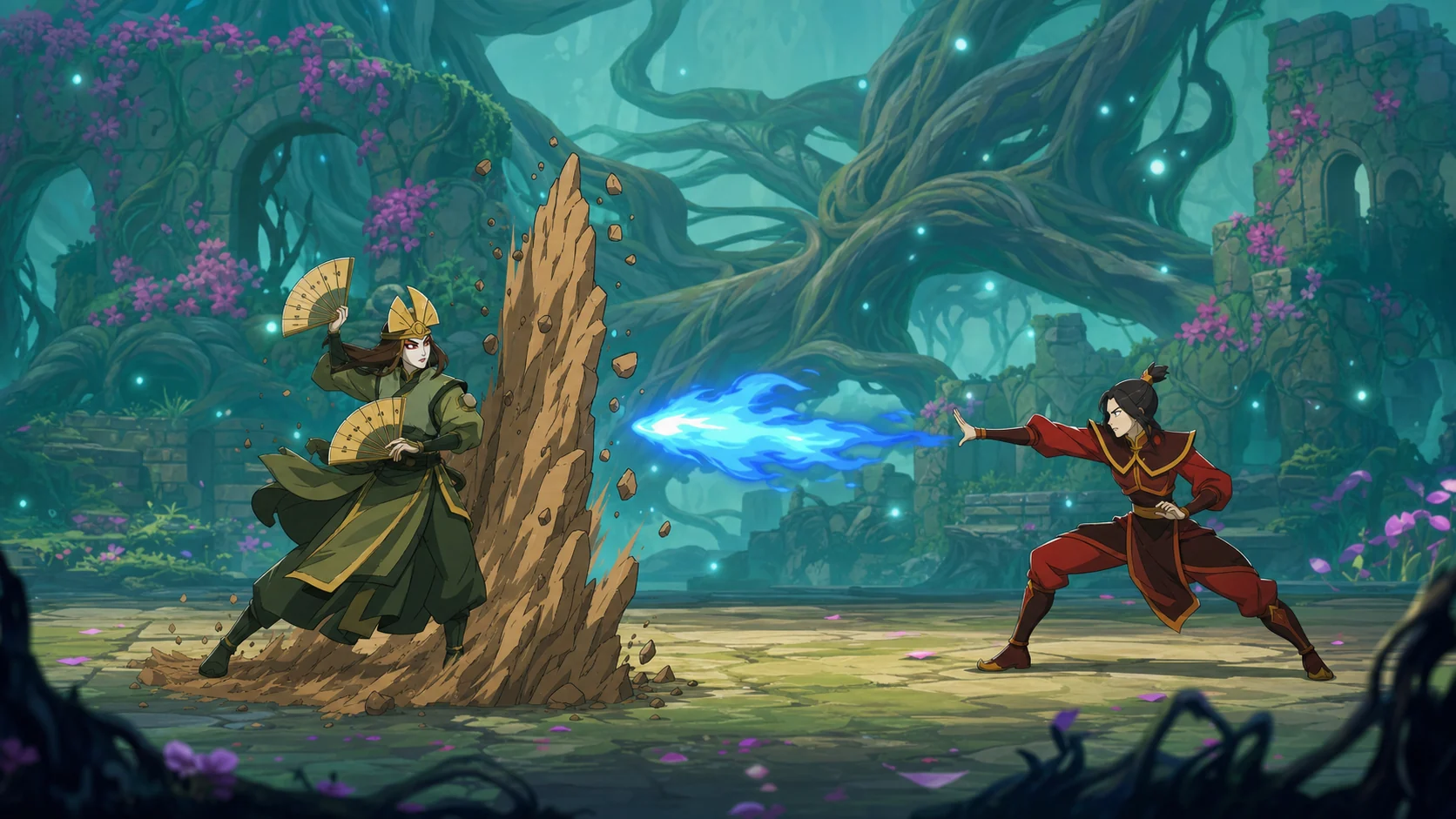
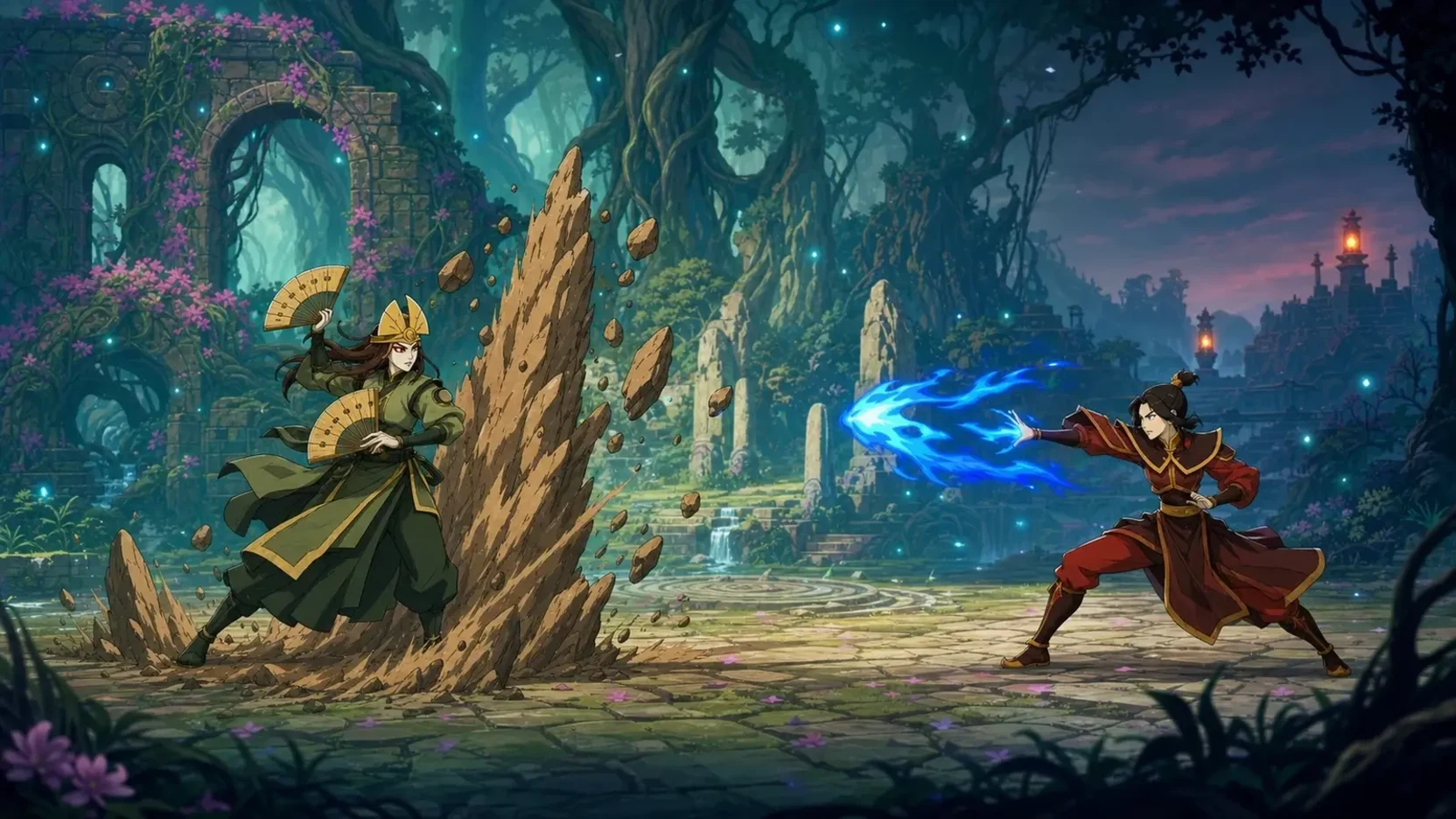
SPIRIT WILDSKyoshi versus Azula
Art Gallery
Avatar Legends The Fighting Modes include an Art Gallery
The Art Gallery is not a practice mode, but it is a meaningful part of the package. Official descriptions promise never-before-seen concept art connected to the show, character designs, stages, and the game’s hand-drawn production. For fans, that archive can be as valuable as a short competitive feature.
The gallery also helps explain why the animation feels distinct. Developers describe roughly 900 illustrated frames per fighter, compared with an earlier internal target around 750. Do not treat that estimate as a frame-data statistic; it describes production artwork, not the timing of attacks.
Recommended route
Which Avatar Legends The Fighting Modes should you play first?
For a new fighting-game player: complete the universal How to Play material, run one Character Lesson, spend twenty minutes in Training Mode, play one Arcade route, and then use the online option available in the current build. Note or capture one repeated problem and move it back into Training. That loop connects instruction, execution, application, and review without depending on an announced playlist.
For an experienced competitor: confirm universal defensive rules, inspect Flow and support interactions, test frame data for your shortlist, then seek repeated sets through the current online tools before treating future Ranked results as matchup evidence. Early competitive data will remain noisy while character knowledge and platform access are uneven.
For an Avatar fan focused on narrative: start with Story, follow with each favorite character’s Arcade route, and explore the Gallery. Use Character Lessons when a fight becomes confusing. The game’s accessible inputs do not require you to become a tournament player to appreciate its animation and era-crossing premise.
For local groups: verify controller compatibility, map buttons before the set, use Local Versus, and rotate fighters. Among the Avatar Legends The Fighting modes, Local Versus is the least dependent on server population or future playlist updates. Add a short teaching rule—one tip after each match—so the stronger player does not turn every round into an unexplained demonstration.
Mode questions
Avatar Legends The Fighting Modes FAQ
Does the game have a story mode?
Yes. It has an original time-and-space narrative outlined by Michael Dante DiMartino and Tim Hedrick, bringing characters from different Avatar eras together.
Can two people play offline?
Yes. Local Versus supports offline head-to-head play. Training documentation also describes two-player practice possibilities.
What online modes are available?
Current official launch descriptions confirm online play with rollback netcode and cross-play on supported platforms. Ranked is announced for the first season, while lobbies and spectator mode are named post-launch priorities without an exact date. Older replay marketing is not treated here as current shipping confirmation.
Does Training Mode show frame data?
Yes. Official store pages specifically mention frame data, hitboxes, save states, and advanced training tools.