
Play toward
- Threaten both grounded fire and airborne entry.
- Keep one support identity per set.
- Verify in Training Mode.
Fire fighter dossier · Launch version
Zuko is the launch fire character for players who want clear fundamentals without giving up layered decision-making. Official trailer language sells him through divekicks and an honorable techniques theme, while community documentation maps an all-rounder whose support choice can tilt the plan toward projectiles, movement, or divekick pressure. This page keeps Zuko grounded in that evidence line: use what is officially shown first, then test every community claim inside Training Mode before treating it as stable match knowledge.
On this page
Evidence status
Zuko has official confirmation for his techniques overview, fire-nation identity, and divekick-forward presentation. The deeper Redemption and support mapping on this page is clearly labeled as current community documentation that should be verified in your own build.
Reviewed July 24, 2026Character overview
Zuko succeeds when he feels measured rather than frantic. Official material confirms a divekick-focused route inside the game's Flow and support systems, while community notes describe an all-rounder with Redemption and support details that should be treated as lab work.
Character reel · Official technique footage
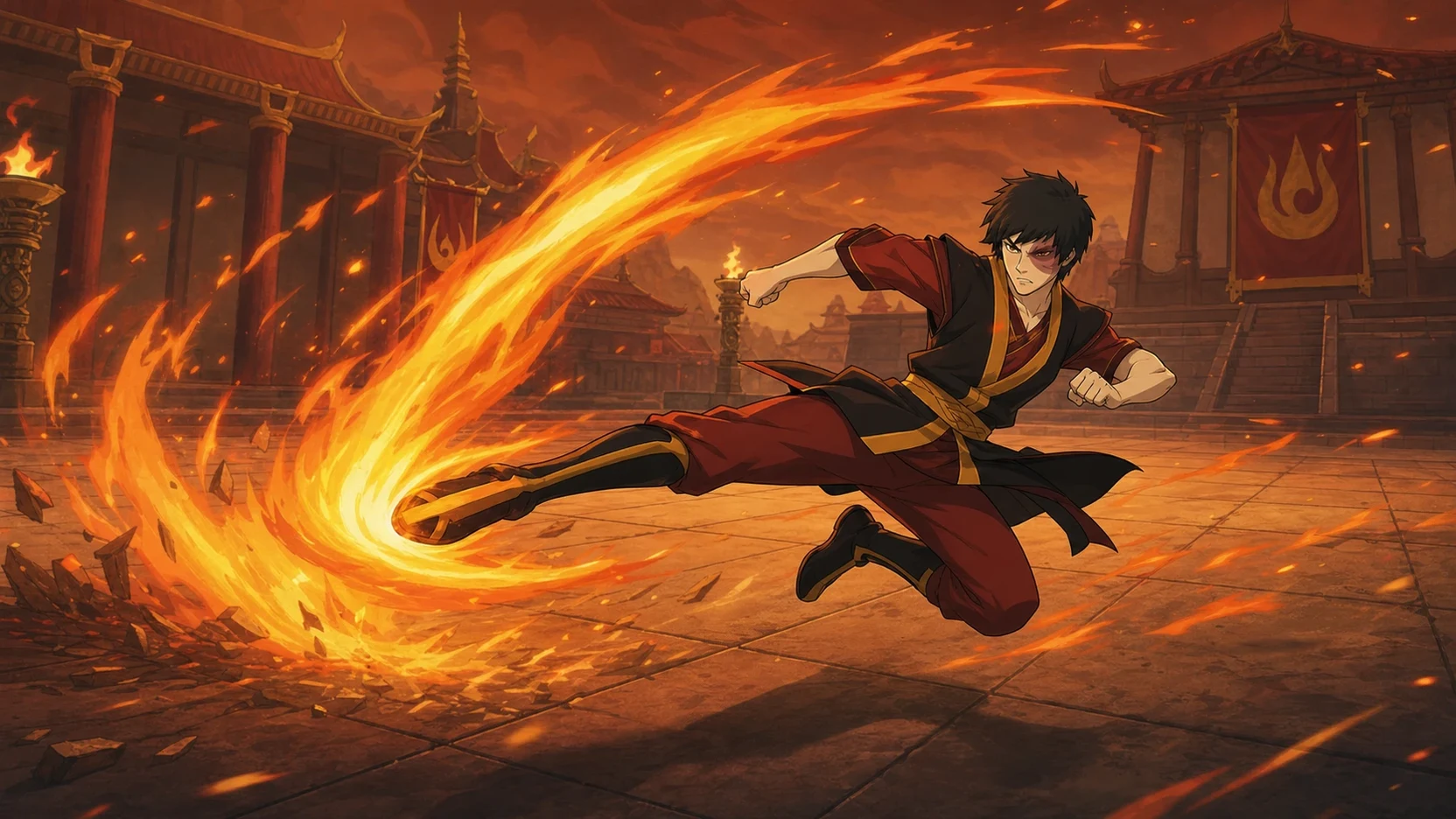
The official Zuko Techniques 101 clip isolates the divekick, so it is useful for observing approach angle and contact timing. Treat it as one Zuko tool inside a grounded plan, then verify height restrictions, recovery, and the opponent's anti-air options.
Use Zuko's stable close check and midrange poke until the opponent gives a reason to risk an aerial approach.
Test Zuko's divekick from multiple heights and distances, recording which versions are punishable or miss crouching targets.
Spend or commit to a fire technique only after Zuko's starter actually connects.
Button labels use universal notation. Confirm the current command list and support effects in your own game build.
Launch read
Zuko is a fire pick for players who want their early decisions to stay readable. Current community documentation describes grounded fire, projectiles, and airborne entry as complementary lanes, but the exact strength of each lane still belongs in Training Mode.
The official divekick clip confirms that aerial route, which matters because it tells you not to treat this fighter as a pure grounded shell. If opponents wait for fire, test the air. If they stare upward, walk them back into simpler pressure.
Official material
Official material around Zuko is narrower than launch chatter suggests. The official Techniques 101 clip confirms a divekick-focused route, while the official site and Steam page confirm the systems around him: Flow movement, support selection, and a Training Mode with hitboxes, frame data, and save states.
The safe summary is simple. This fighter blends grounded structure with aerial commitment inside a system where movement, support changes, and resource routing all matter. Exact punish talk and stable combo claims sit outside official confirmation.
Community mapping
The clearest community document right now is the SuperCombo page, and it openly warns that it is still being written and may be inaccurate. Even so, the broad picture is useful: a fire all-rounder with strong projectiles, real air presence, and a Redemption Gauge that extends offense as it grows.
That changes practice. Do not ask only whether a fireball or divekick works once; ask whether the choice builds toward a better later turn. Community notes split the supports into three study lanes: Mai for projectiles, Ran and Shaw for speed, and June for divekick emphasis.
Neutral game
Early Zuko should win by reducing guesswork, not by increasing spectacle. Start from the ranges where he can reveal whether the opponent fears grounded fire or airborne entry more. Once that answer appears, lean harder into one branch.
The biggest practical mistake is spending Flow before a real defensive reaction has appeared. This fighter becomes teachable when every sequence begins with one clean question: block, move, or watch the sky.
Support route
This fighter gets much easier once you stop pretending every support is the same lesson. Pick one route and keep it for a full lab block. Current community mapping suggests Mai for projectile play, Ran and Shaw for speed, and June for divekick routes.
The payoff is clarity. One support focus tells you whether pressure is landing because of timing, spacing, or a support-specific benefit.
Match discipline
A good Zuko round should look calmer than the opponent expects. Make one option credible, collect the defensive answer, then route into the counter-answer. If the round opens with a projectile threat, observe the jump, duck, or patience that follows.
That is also how Zuko stays honest under pressure. When he is behind, it is tempting to force the divekick or burn Flow to prove activity. Resist that urge.
Practical match plan
This launch-version playbook separates durable decisions from early community conclusions that may change after balance updates.
Training mode checklist
The shipped Training Mode exposes hitboxes, frame data, save states, and configurable situations. Use it to reproduce every exact claim.
Stand at your common fireball range. Record jump, wait, and forward movement. Test which answer repeats best.
Run twenty air approaches without trying to hit. Learn which jump arcs disguise the divekick threat.
Keep one support for a full session. Note what changes before switching at all.
Using community notes as a hypothesis, recreate the situations that are supposed to build Redemption. Confirm only what your version shows on screen.
Start at a life deficit with normal resources. Practice one calm re-entry to neutral.
Character questions
Zuko can be an approachable fire starting point if you want a compact plan built around grounded checks, a confirmed divekick route, and one support lens.
Current community documentation says yes, but that source also warns it is incomplete. Verify it in your build instead of treating it as settled law.
Start with whichever choice helps you understand range better. Official material highlights divekicks, but the kit becomes easier when the air route and the fire route teach each other.
Use support choice as a training theme. Community notes frame Zuko around projectile, movement, or divekick lenses, and that keeps practice organized.
Source desk
Sources were reviewed on July 24, 2026. Live game behavior and storefront terms can change after publication.